Pages

Saturday, March 21, 2015

Review: OGK Kabuto FF-5V Helmet

It’s been almost 6 month since I bought my FF5V Helmet from OGK Kabuto to replace my old Shark S700 Helmet, and I use it everyday, everytime whether it is sunny or raining. So, I’ll make my own review about it.

INTRODUCTION
FF-5V is the highest model full face helmet from OGK Helmet, it was made to replace its predecessor the FF-5. The FF-5V provides comfort and safety through a lightweight and strong Advanced Composite Technology (A.C.T) shell material, with CoolMax interior, and Top Air Ventilation System (T.A.V.S) that gives a superb air circulation.

SHIELD AND VISIBILITY
The FF-5V provides a really wide visibility from top to bottom, and side to side view. I just need to turn my head a bit to check is there anyone behind me that I can’t see on the mirror. And this is where the Wake Stabilizer works. No buffeting or shaking at high speed. It has a SAF quick change shield system which make shield changing much faster and easier. To open and close the shield, just push the small black knob on the left side of the shield. Also it helps to ensure that the face shield stays closed while speeding.

VENTING AND NOISE
The FF-5V has three air intakes (one chin vent, two top vents), and two exhaust ports (top position). The T.A.V.S are awesome, you can start to feel the wind even with a half-opened top vents. For the exhaust ports I have no idea if it’s really working or not but I’m not complaining.
For the noise, I will say it’s quiet. No whistling sound when I rush above 100 km/h with fully opened vents although there are low frequency rumbling sound that still acceptable, but I haven’t tried more than that.

CONCLUSION
For a top class helmet that cost below US$ 600, FF-5V is one of the best. It has so many features that works great that can’t be found at any other helmet on its class.

When I meet my FF-5V for the first time. It was accompanied by the other two big japanese brands.
Side by side with my old Shark S700 Scott Redding Edition.
When I bought it Gold Iridium Face Shield.

Get caught by the storm on the way back. :'(


Saturday, March 14, 2015

Refreshing at Ragunan Zoo

It’s been a while since the last time I went birding especially after I become very busy with my new job as a Barista (Although I really enjoy it).
After almost one year with no birding activity I become restless because I missed my feathered friends. So, to satisfy my desire to go birding I ask my brother to go around. Lucky me, he’s already arrange the trip before I ask him.

To Ragunan Zoo we go, together with my friends we start to bird at around 8AM. At the car park my brother found a baby Radiated Rat Snake (Coelognathus radiata), after we took some pictures he decided to move the snake to the safer place, because the car park is too dangerous for him.

Radiated Rat Snake (Coelognathus radiata)
Defense Mode: On
Inside the zoo, we got more species from the small fella like Olive-backed Tailorbird to the large one like Sulphur-crested Cockatoo. What makes our trip more memorable is because of the hybrid species Cockatoos (Yellow-crested x Tanimbar / Goffin's). They're a feral species but I'm glad they survive there. At the end of the day we tick more than 25 species (Most of them are my Big Year ticks), it’s a very quick trip for us (only 4 hours) but me personally really enjoy it.
Common Myna (with Spotted Dove in the background)
Red-breasted Parakeet on Rambutan Tree
Red-breasted Parakeet feeding on Rambutan Fruit
Sleepy Cockatoo (Looks like a Goffin's Cockatoo, right?)
In this picture, it shows the yellow crest (Left), Yellow-crested Cockatoo x X Cockatoo? (Right)

Wednesday, March 6, 2013

Birding Trip to Island of gods.

Some people thinks birding is a weird or "crazy" thing to do, because some they're willing enough to fly to another islands even to another country to find their targets. That's what I do on 06 February 2013 although I'm not that crazy. on December 2012 my friends from Bali found a Caspian Tern Hydroprogne caspia which make me feeling anxious because it's a vagrant to Indonesia. There's only few records in several year and not from Bali. Later, I book a flight to Bali at the end of January, luckily I found a promo ticket just one day before it closed. After I send message to my friends that my flight has been confirmed, they start to "poison" my mind by sharing some bird images, like White-headed Stilt Himantopus leucocephalus, Far Eastern Curlew Numenius madagascariensis and many more.

I spend most of my time visiting Pulau Serangan / Turtle Island try to find my main target bird. For the first three days it gives good result, I got my shorebirds plus a bonus dark morph Pacific Ree Egret Egretta sacra but no Caspian. And on day two, I got a chance to visit Nusa Dua Lagoon where I got two lifers (Little Pied Cormorant Phalacrocorax melanoleucos and Rufous Night Heron Nycticorax caledonicus). On day four and five, I went to visit Bali Barat National Park with my friends Mr. Yuyun and Mr. Golkariadi, although we arrive late evening due the slow moving traffic but on the fifth day, we spend full day birding there. At this area, I managed to get some good birds like Savanna Nightjar Caprimulgus affinis, Chestnut-headed Bee-eater Merops leschenaulti, and the endemic and critically endangered Bali Myna Leucopsar rothschildi. Special thanks to Mr. Hery and Bonenk for providing a place to stay, transportation and guiding us there. On the last three days, the situation at Pulau Serangan became "dire" because I don't see any Curlews nor Godwits on their roosting area. Only my old friends Little Egret Egretta garzetta and Javan Plover Charadrius javanicus that always there. But patience yields a good result, I managed to get Great Egret Egretta alba in peak breeding plumage.

At the end of my visit, I missed both Caspian and Stilt. But I'm still happy with overall result. More than that, I'm happy because I can  meet my friends and we have a good birding time together, and full of fun too.

Here is some pictures from my trip, hope you guys enjoy it:

Dark Morph Pacific Reef Egret (Left), and Grey Plover (Right)
Adult Purple Heron (Left), and Adult Black-crowned Night Heron in breeding plumage (Right)
Adults Great Egret assuming breeding plumage (Left), and non-breeding plumage (Right)
Small Blue Kingfisher (Left), and Adult Great Egret assuming breeding plumage (Right)
Eurasian Curlew (Left), and Bar-tailed Godwits (Right)
Gull-billed Terns in flight
Eurasian Curlew and Far Eastern Curlews (Left), and Whimbrel and Common Greenshank (Right)
Far Eastern Curlews
Sunda Teal (Left), and Whimbrel flock (Right)
Common Greenshank group.
Javan Plover Territorial Dispute
Adult Great Egret in breeding plumage (Left), and Little Egret missed its dinner (Right)
Black-crowned Night Heron (Left), and Little Egret (Right)
Little Pied Cormorant (Left), and Size comparison between Great Egret and Intermediate Egret (Right)
Javan Plover (Left), and Common Sandpiper roosting on fish trap (Right)
Juvenile Blue-tailed Bee-eater (Left), and Adult Chestnut-headed Bee-eater (Right)
Male Grey-cheeked Green Pigeon (Left), and Female Grey-cheeked Green Pigeon (Right)
Bali Starling
Zebra Dove (Left), and Island Collared Dove (Right)
Male Olive-backed Sunbird (Left), and Male Orange-breasted Green Pigeon (Right)
Blue-tailed Bee-eater (Left), and Savanna Nightjar (Right)


Tuesday, January 8, 2013

Trip to Yogyakarta 12-21 November 2012

It was my first visit to Yogyakarta, it took around 12 hours by train from Jakarta. I went there with my brother Khaleb for Merapi Birdwatching Competition. Actually, Birdrace isn't our main purpose, but we're looking for the Shorebirds that always come yearly to their wintering ground. From our 9 days in Yogyakarta, we spent 5 days visiting Progo - Trisik River Delta and Trisik Beach looking for any Shorebirds that can be found there, 3 days at Mt. Merapi National Park for the bird race, and 1 day rest at our base camp. Highlighted species from our visit to Trisik is Oriental Plover, Oriental Pratincole, Great and Red Knot, Bar-tailed Godwit, Osprey, Gull-billed Tern, Little Tern. While from Merapi, we yield some endemic species and rare migrant like Blue-winged Leafbird, Javan Whistling Thrush, Orange-spotted and Sunda Bulbul, Javan Fulvetta, Siberian Thrush, Sunda and Scarlet Minivet, and the rare and endemic Javan Hawk Eagle. At the end I would like to say thanks to Imam, Kukuh, Shaim, Wahb, and the rest of KPB Bionic UNY members for sharing their playing ground and providing a place for us to stay, and Panji who pick us up from the train station very early morning on our arrival.

Here is some pictures from our visit to Yogyakarta:

Female Blue-eared Kingfisher from KPB Bionic UNY Base Camp.
Paddyfield Pipit is a common bird at Trisik Beach.
Paddyfield Pipit is a rather tame bird that allow photographer to come really close.
Javan Munia is the most common munia on rice field near Trisik Beach.
White-capped Munia is easily overlooked as White-headed Munia but lack of dark throat.
Juvenile Barn Swallow from Progo - Trisik River Delta.
A couple of Lesser Whistling Duck roosting at Trisik Lagoon.
Osprey is a regular winter visitor to Trisik Lagoon.
Osprey usually drives the other birds crazy, although it is feeding on fishes.
Just like other BOP, Osprey won't allow you to get close less than 50 meters away.
Common Greenshank is extremely sensitive with human.
A couple Wood Sandpiper roosting at Trisik Lagoon.
Wood Sandpiper known as the shorebirds alarm, once they fly off the others will follow.
I managed to get this skittish Common Sandpiper a couple meters away from my motorbike.
Sanderling is a common winter visitor to Trisik Beach.
Probably this Sanderling got a tumor on its throat. Note: The red balloon.
Adult Sanderling in full winter plumage from Trisik Beach.
A small flock of Sanderling from Progo - Trisik River Delta.
Little Ringed Plover is a uncommon winter visitor to Trisik Lagoon.
Rufous-necked Stint is the smallest shorebird at Trisik.
Rufous-necked Stint with a black orange flag of Java Island.
Rufous-necked Stint in winter plumage.
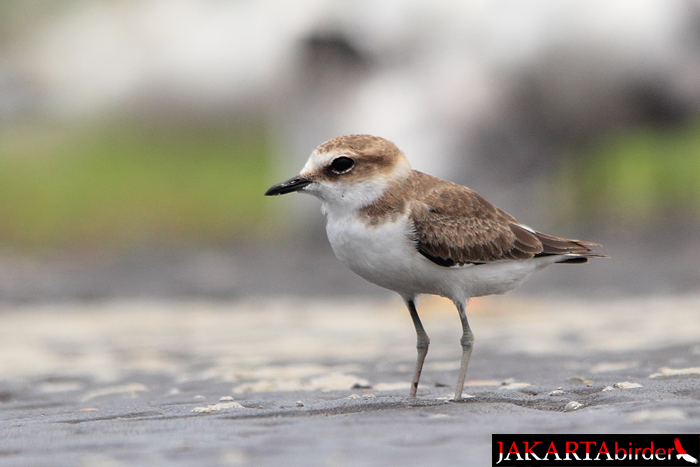
Javan Plover is the only resident shorebirds.
White-winged Tern with Great Crested Terns in background.
White-winged Tern is a common winter visitor to Progo - Trisik River Delta.
White-winged Tern in winter plumage shows black patch from pale crown to ear-coverts extends below eyes.
White-winged Tern usually roost at Progo - Trisik River Delta.
Gull-billed Tern has thick black bill. Photo shows with Bar-tailed Godwits, Great Knots and Great Crested Tern in background.

Little Tern has the slimmest body build than the other terns at Progo - Trisik River Delta.
Little Tern is the smallest tern that can be found at Progo - Trisik River Delta.
Little Terns usually roost with other terns too like Great Crested Terns in background.
Little Tern in winter plumage shows dark bill and legs, and blackish hindcrown and nape.
It has dark leading edge to inner wing and blackish outermost primaries too.
A mixed flock of Great and Red Knots, Pacific Golden Plover, Bar-tailed Godwits, and Gull-billed Tern.
A mixed flock of Great and Red Knots, Bar-tailed Godwit, and Great Crested Tern.
Great Knot flock with Black-tailed Godwits in background.
Great Knot roosting at Progo - Trisik River Delta.
Pacific Golden Plovers is a common winter visitor to Trisik Lagoon.
Pacific Golden Plover from Progo - Trisik River Delta.
Pacific Golden Plover foraging on water edges of Trisik Lagoon.
A mixed flock of Pacific Golden Plover, Great Knots and Bar-tailed Godwits.
Bar-tailed Godwit roosting with Great Crested Terns.
A couple of Bar-tailed Godwit roosting at Progo - Trisik River Delta
Size comparison between Bar-tailed Godwit and Great Knot.
A couple of Bar-tailed Godwit.
A couple of Bar-tailed Godwit foraging at Progo - Trisik River along with Great Crested and Little Tern.
Juvenile / 1st Winter Bar-tailed Godwit with Great Crested Terns in background.
Bar-tailed Godwit has a slightly upturned bill.
 Bar-tailed Godwit is a fairly common winter visitor to Progo - Trisik River Delta.
A group of Bar-tailed Godwit at Progo - Trisik River Delta.
Common Tern is a uncommon winter visitor to Progo - Trisik River Delta.
Common Tern with Little Tern and Great Crested Terns in background.
Great Crested Tern in flight.
Great Crested Tern is a rather tame species. You can get really close by crawling.
A big flock of Great Crested ready to fly when the tide is rising.
Great Crested Tern is the largest tern that can be found at Progo - Trisik River Delta.
Comparison between Great Crested Tern in non-breeding (left) and breeding plumage (right).
Great Crested Tern in winter plumage shows white forecrown, white-streaked black hindcrown/nape and cold yellowish bill.
A group of Great Crested Terns roosting on bushy area of Progo - Trisik River Delta.
Trio Bar-tailed Godwit in flight.
Grey Heron usually harassing the Great Crested Terns.